What Workforce Coaches Actually Need to Be Good At
Apr 22, 2026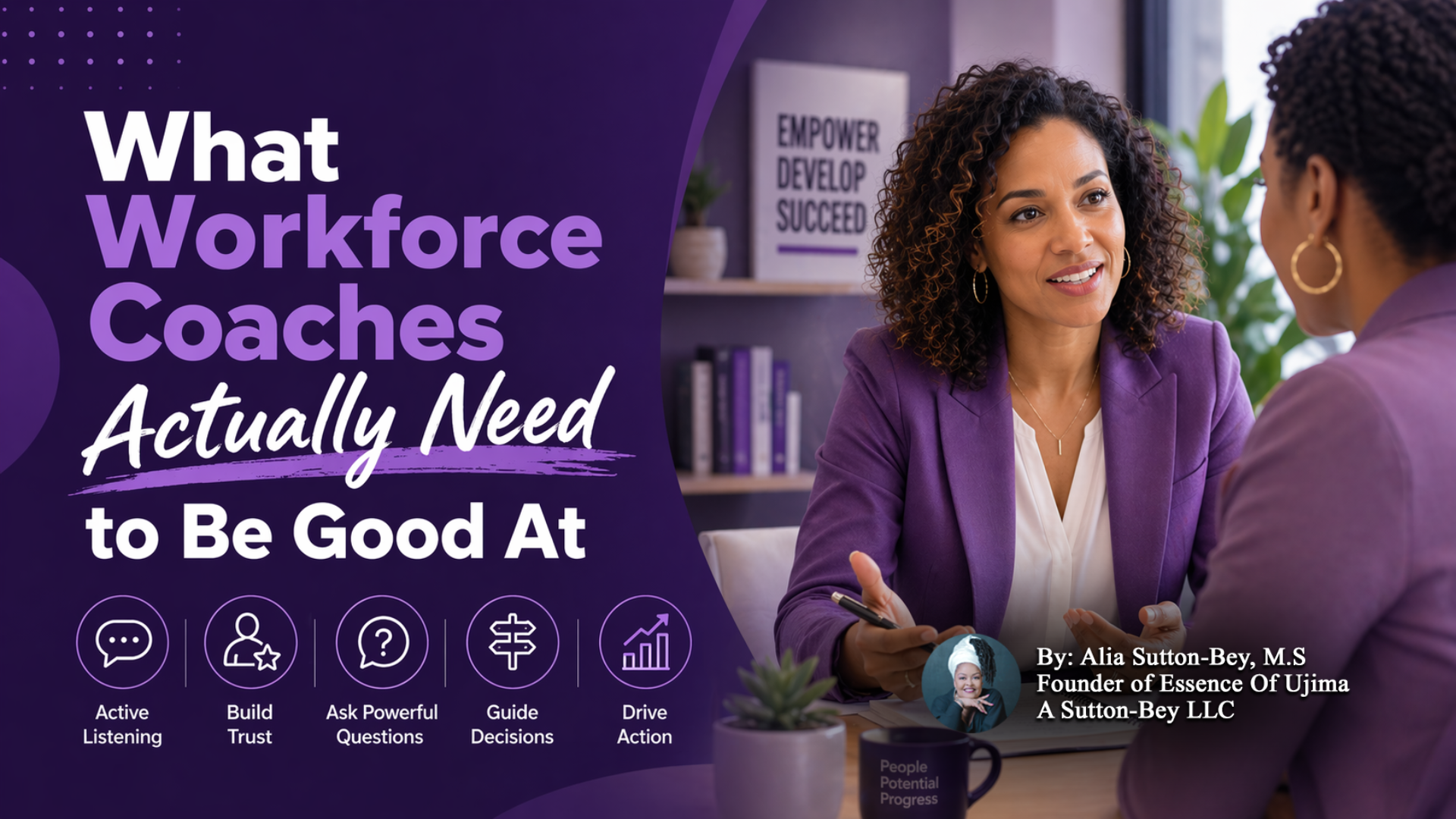
Two weeks ago, I wrote about the lie we tell about workforce coaching—that it’s “just support.”
If that’s not true, then we need to be honest about something else:
We are asking people to do a job we haven’t clearly defined.
And when a role isn’t clearly defined, we default to personality.
“She’s great with people.”
“He really cares.”
That’s not a skillset.
That’s a gamble.
If coaching is going to function as the backbone of workforce programs, then we need to name—clearly—what the work actually requires.
Not in theory.
In behavior.
Coaching Is Not One Skill. It’s a Stack of Capabilities.
At its core, workforce coaching requires a combination of distinct, trainable skills.
Not vibes. Not instincts.
Skills.
Here are four that show up consistently—and what they actually look like in practice.
1. Expectation Setting & Boundary Management
(The ability to build trust while maintaining standards)
This is where most people get it wrong.
We tend to separate “support” and “accountability” as if they are opposites.
They’re not.
The real skill is the ability to hold both at the same time.
What this looks like behaviorally:
- Sets clear expectations early and revisits them consistent
- Names gaps in behavior without avoiding or softening the message
- Maintains composure in moments of resistance or defensiveness
- Builds trust without over-accommodating or lowering standards
- Follows through on boundaries and stated consequences
This is not just empathy.
This is structured empathy with standards.
2. Systems Navigation
(The ability to understand and move within complex systems)
Most workforce programs are made up of overlapping systems:
- education
- workforce
- organizational
- and sometimes government or funding structures
Coaches are expected to operate inside all of them.
But we rarely name that as a skill.
What this looks like behaviorally:
- Understands how decisions are made across the program ecosystem
- Identifies where authority lives—and where it doesn’t
- Escalates issues appropriately instead of over-functioning
- Recognizes when a problem is structural vs. individual
- Navigates policies and processes without creating unnecessary friction
This is not just “being organized.”
This is situational awareness + operational navigation.
3. Communicating Expectations & Standards
(The ability to make standards clear, relevant, and actionable)
A significant portion of coaching breakdowns come from one issue:
People don’t actually understand what’s expected of them.
Not because expectations don’t exist—
but because they haven’t been translated.
What this looks like behaviorally:
- Breaks down workplace expectations into clear, specific behaviors
- Connects actions to consequences (both positive and negative)
- Uses real examples instead of abstract language
- Checks for understanding instead of assuming alignment
- Repeats and reinforces expectations over time
This is not just communication.
This is behavioral clarity.
4. Behavioral Feedback & Accountability
(The ability to address gaps without damaging the relationship)
This is where coaching either works—or completely falls apart.
Most people avoid these moments or handle them inconsistently.
But this is the work.
What this looks like behaviorally:
- Addresses issues early instead of waiting for escalation
- Names specific behaviors, not general character judgments
- Stays grounded in observable facts
- Holds the line on standards without becoming punitive
- Keeps the conversation focused on forward movement
This is not conflict avoidance.
This is direct, regulated intervention.
These Are Not Personality Traits. They Are Trainable Skills.
When we don’t name these capabilities, we default to hiring based on “fit” or “energy.”
But what we’re actually asking for is:
- relational authority
- systems literacy
- expectation translation
- accountability conversations
These are professional skills.
Which means they can be:
- taught
- practiced
- observed
- and measured

Final Thought
If workforce coaching is going to drive real outcomes, we have to move beyond generalities.
We have to get specific.
Because the moment you can name the skill,
you can build it.
And right now, too many programs are expecting performance from a role they haven’t fully defined.